Initial site assessment and safety briefing
Before any heavy machinery is turned on, the crew will perform a walkthrough of your property. They need to identify property lines, locate underground utilities, and flag any vegetation you want to keep. This is the time to confirm the project scope and ensure all parties are aware of potential hazards, such as hidden drainage pipes or septic lines common in residential plots.
- Clearly mark items to be preserved with bright tape
- Provide documentation of utility line locations
- Walk the perimeter with the lead operator
Defining the work zone
Your property may require different approaches depending on whether the land is heavily wooded or overgrown with brush. The team will establish a safety perimeter to protect surrounding structures. Because the soil in this region can vary from sandy loam to dense clay, the crew will also evaluate ground conditions to ensure machinery can operate without causing excessive soil compaction or rutting.
- Clear all vehicles and pets from the work area
- Remove loose debris from the path of equipment
- Ensure gate access is wide enough for heavy machinery
Mechanical clearing and vegetation removal
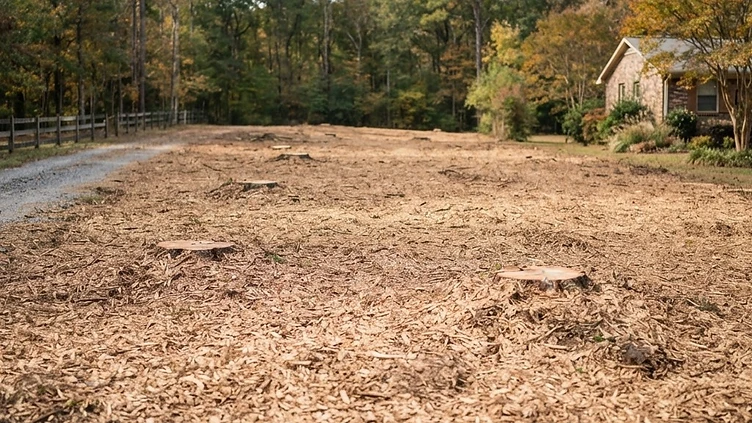
The core of the work involves using specialized equipment like forestry mulchers or excavators to clear trees and brush. Rather than hauling away every piece of biomass, many modern operations use mulching, which grinds material into small chips that remain on the forest floor. This approach helps control erosion and adds nutrients back into the soil as the organic matter breaks down over the following months.
- Heavy machinery grinds vegetation on-site
- Trees are often removed from the root to prevent regrowth
- Remaining mulch provides a temporary erosion barrier
Managing debris and stumps
Once the vegetation is down, the crew addresses the stump and root structures. Depending on your goals, these may be extracted fully, ground below the surface, or left for later removal if they are outside of a building footprint. If the project involves clearing for a foundation, complete extraction is standard to prevent structural settling later.
- Confirm if stump grinding is included in your estimate
- Assess if full root extraction is required for new construction
- Discuss disposal options if debris cannot be mulched on-site
Site cleanup and final walkthrough
After the main mechanical work is finished, the crew clears the site of larger rocks or displaced soil piles. They will perform a final pass to ensure the ground is leveled to your expectations. This is your chance to review the results against your initial project plan and point out any missed areas that need immediate attention.
- Inspect the boundary lines for uniform clearance
- Check for excessive ruts or surface damage
- Confirm the debris management plan was followed
Common questions
Sources and further reading
- Tree Removal in Georgia: When It Is Necessary and What to Expect — Georgia Tree Authority
- Land Disturbance Process | South Fulton, GA — City of South Fulton